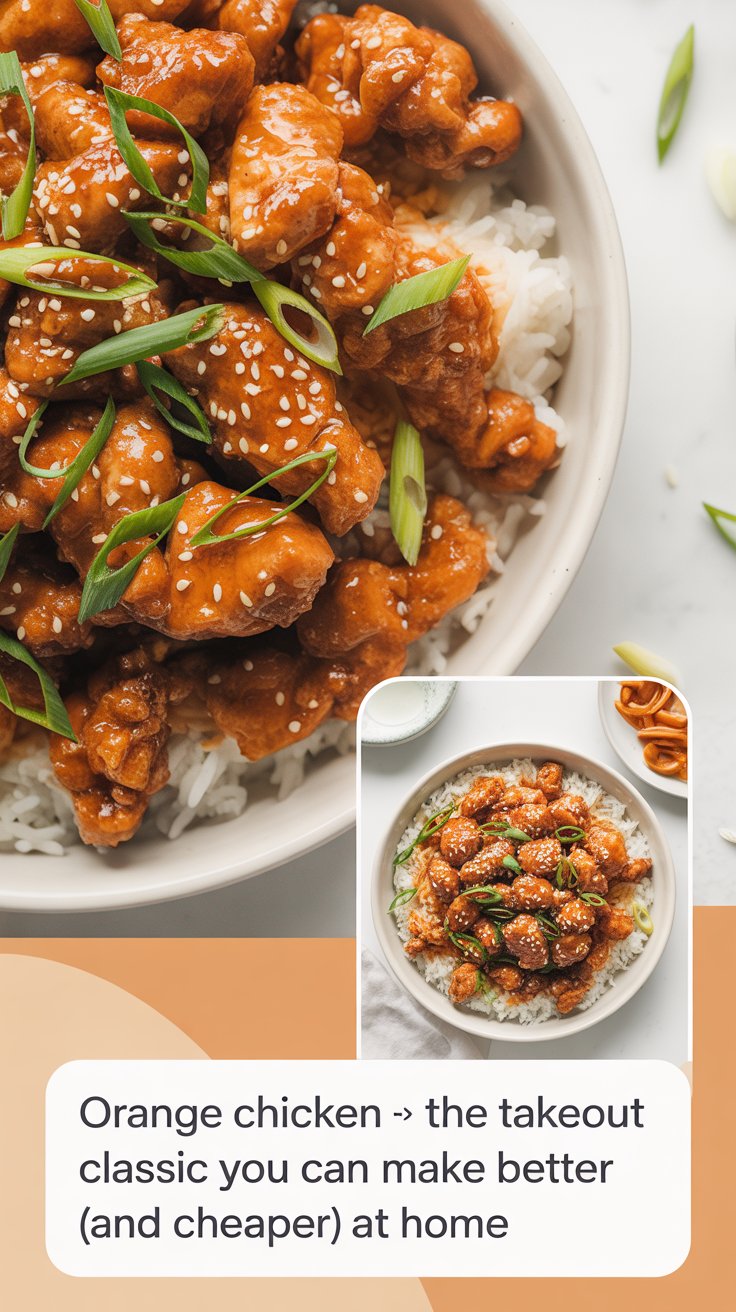
Orange Chicken: The Takeout Classic You Can Make Better (and Cheaper) at Home
Let’s talk about the dish that makes everyone weak in the knees when they open those little white takeout boxes. Orange chicken—that perfect combination of crispy, tender chicken coated in a glossy, sweet-tangy orange sauce—is the undisputed champion of Chinese-American cuisine. It’s the reason people order takeout on Friday nights, the dish that converts picky eaters, and the meal that always hits the spot.
But here’s the thing: you can make orange chicken at home that’s actually better than takeout. Crispier coating. Fresher ingredients. More orange flavor. Less grease. No questionable mystery meat. And you’ll save a ton of money while impressing everyone who thought this level of deliciousness only came from restaurants.
Whether you’re craving that classic takeout taste, trying to master restaurant-style cooking at home, feeding a family on a budget, looking for a crowd-pleasing dinner that always works, or just wanting to know exactly what’s in your food, this recipe has you covered. It takes about 45 minutes from start to finish, and every single bite is worth it. Once you make this, delivery will never look the same.
Ingredients
For the Chicken:
- 1½ lbs boneless, skinless chicken breasts or thighs – thighs are juicier and more forgiving
- ½ cup cornstarch – creates that signature crispy coating
- ¼ cup all-purpose flour – helps the coating stick
- 2 large eggs, beaten
- 1 teaspoon salt
- ½ teaspoon white pepper – or black pepper
- ½ teaspoon garlic powder
- Vegetable oil for frying – about 1-2 cups depending on pan size
For the Orange Sauce:
- ¾ cup fresh orange juice – about 2-3 oranges; fresh is crucial!
- Zest of 1 orange – this is where the real orange flavor lives
- ⅓ cup granulated sugar – or honey for a more natural sweetness
- ¼ cup rice vinegar – or white vinegar in a pinch
- 3 tablespoons soy sauce – low-sodium preferred
- 2 tablespoons water
- 1 tablespoon sesame oil – adds nutty depth
- 1 tablespoon cornstarch – for thickening
- 4-5 cloves garlic, minced – don’t skimp!
- 1 tablespoon fresh ginger, grated or minced – jarred works but fresh is better
- ½-1 teaspoon red pepper flakes – adjust to your heat preference
- 2-3 dried red chilies – optional but adds authentic look and heat
For Garnish & Serving:
- 2-3 green onions, sliced – green parts only
- 1 tablespoon sesame seeds – toasted if possible
- Fresh orange slices – optional but pretty
- Steamed white or brown rice – for serving
- Steamed broccoli – classic pairing
Step-by-Step Instructions
Step 1: Prep the Chicken (8 minutes)
The key to restaurant-quality orange chicken starts with properly prepared chicken pieces.
Cut your chicken into bite-sized pieces—about 1-inch cubes. Try to keep them relatively uniform in size so they cook evenly.
Pro tip: Slightly freeze the chicken (about 20-30 minutes in the freezer) before cutting. It firms up and makes cutting much easier and cleaner!
Should you use breasts or thighs?
- Chicken breasts: Leaner, milder flavor, can dry out if overcooked
- Chicken thighs: Juicier, more flavorful, more forgiving, stay tender even if slightly overcooked
- My recommendation: Use thighs or a mix of both!
Place the chicken pieces in a bowl and season with:
- Salt
- White pepper (or black pepper)
- Garlic powder
Toss to coat evenly. Let this sit while you prepare everything else—the salt helps tenderize the meat.
Common mistake to avoid: Don’t cut the pieces too large or they won’t cook through properly. Don’t cut them too small or they’ll dry out. One-inch cubes are the sweet spot!
Step 2: Make the Magical Orange Sauce (10 minutes)
This sauce is the star of the show, and making it from scratch means you control the flavor balance perfectly.
First, prepare your aromatics:
- Mince the garlic finely (about 4-5 cloves—yes, really!)
- Grate or mince the fresh ginger (about 1 tablespoon)
- Zest one orange before juicing it
In a medium bowl, whisk together:
- Fresh orange juice (¾ cup)
- Orange zest (don’t skip this—it’s liquid gold!)
- Sugar
- Rice vinegar
- Soy sauce
- Water
- Sesame oil
- Cornstarch (make sure it’s fully dissolved with no lumps!)
Taste the sauce mixture at this point. It should taste quite sweet, tangy, and salty—almost too intense. That’s perfect! It’ll mellow out when combined with the chicken and rice.
Set the sauce mixture aside. We’ll cook it later with the garlic and ginger.
Pro tips for the sauce:
- Fresh orange juice is non-negotiable! Bottled juice tastes flat and artificial
- Zest before juicing—it’s nearly impossible to zest after you’ve cut the orange
- Adjust sweetness: Like it sweeter? Add more sugar. Want it tangier? Add more vinegar
- Make it spicier: Increase red pepper flakes or add sriracha
Can you make sauce ahead? Yes! Mix everything (except don’t cook it yet) and refrigerate for up to 2 days. Bring to room temperature before using.
Step 3: Set Up Your Breading Station (5 minutes)
Organization is key here. You’ll be working with raw chicken, so let’s do this efficiently!
Set up two shallow dishes:
Dish 1: Beaten Eggs
- Crack 2 eggs into a shallow bowl
- Beat them well with a fork until completely combined
- No streaks of white should be visible
Dish 2: Coating Mixture
- Combine ½ cup cornstarch and ¼ cup flour
- Mix well with a fork or whisk
- This mixture creates that signature crispy, crunchy coating
Pro tip: Use one hand for the wet (egg) and one for the dry (coating). This prevents “club hand” where breading glues itself to your fingers in thick clumps!
Have a large plate or baking sheet lined with parchment paper nearby for your coated chicken pieces.
Step 4: Coat the Chicken (7 minutes)
Time to create that crispy, golden coating!
Take each piece of seasoned chicken and:
- Dip in beaten egg, coating completely. Let excess drip off but don’t shake it too much—you want a good coating.
- Dredge in the cornstarch-flour mixture, pressing gently to adhere. Make sure every surface is coated. The cornstarch is what creates that super-crispy texture!
- Place on your prepared plate. Don’t let pieces touch or they’ll stick together.
Repeat with all chicken pieces. This takes a few minutes but it’s worth the effort!
Once all chicken is coated:
- Let it rest for 5-10 minutes if you have time (this helps the coating adhere better)
- Or you can fry immediately if you’re hungry!
Common mistake to avoid: Don’t double-dip the chicken or coat it too thickly. One good coating is perfect—too much breading makes it gummy instead of crispy.
Step 5: Fry the Chicken to Golden Perfection (12-15 minutes)
This is where the magic happens—crispy, golden perfection!
Heat vegetable oil in a large, deep skillet or wok over medium-high heat. You need about ½ inch to 1 inch of oil in the pan (enough to come halfway up the chicken pieces).
How do you know the oil is ready?
- Drop in a small piece of coating—it should sizzle immediately and float to the top
- Or use a thermometer—350°F to 375°F is perfect
- Too hot = burnt outside, raw inside. Too cool = greasy, soggy coating
Working in batches (don’t overcrowd!), carefully add chicken pieces to the hot oil. Give each piece space—overcrowding drops the oil temperature and makes everything greasy instead of crispy.
Fry for 3-4 minutes per side until deep golden brown and crispy. The coating should look like a gorgeous golden shell. The chicken should reach 165°F internal temperature.
Use tongs or a slotted spoon to turn the chicken gently. Try not to knock off the coating!
Transfer cooked chicken to a paper towel-lined plate to drain excess oil. The paper towels absorb the grease while keeping the coating crispy.
Repeat with remaining chicken, working in 2-3 batches. Make sure the oil comes back up to temperature between batches!
Pro tips for perfect frying:
- Don’t walk away—oil can overheat and burn quickly
- Maintain steady medium-high heat
- Listen for a consistent, energetic sizzle
- If the coating is browning too fast, lower the heat slightly
- Use fresh oil—old oil makes everything taste off
Healthier alternative: You can bake the coated chicken instead! Spray with cooking oil and bake at 425°F on a wire rack for 20-25 minutes, flipping halfway. Not quite as crispy but still delicious and way less oil!
Step 6: Cook the Orange Sauce (5 minutes)
Now let’s turn that sauce mixture into liquid gold!
In a large skillet or wok (you can wipe out and reuse your frying pan if you want fewer dishes), heat 1 tablespoon of oil over medium heat.
Add the minced garlic, grated ginger, red pepper flakes, and dried chilies (if using). Stir-fry for 30-60 seconds until incredibly fragrant. Your kitchen should smell amazing! Be careful not to burn the garlic—it goes from perfect to burnt in seconds.
Give your sauce mixture a quick stir (the cornstarch settles at the bottom), then pour it into the pan with the aromatics.
Bring to a boil, stirring constantly. As it heats, you’ll see it start to thicken from the cornstarch. This takes about 2-3 minutes.
Reduce heat to medium-low and simmer for 1-2 minutes, stirring frequently, until the sauce is glossy, thick enough to coat a spoon, and has reduced slightly. It should look like honey or syrup.
Taste and adjust:
- Too sweet? Add more vinegar or soy sauce
- Too tangy? Add more sugar
- Not enough orange flavor? Add more zest
- Want more depth? Add a splash more sesame oil
Pro tip: If your sauce gets too thick, thin it with a tablespoon of water or orange juice. Too thin? Mix ½ teaspoon cornstarch with 1 tablespoon water and stir in, then simmer until thickened.
Step 7: Combine Chicken and Sauce (2 minutes)
The moment you’ve been waiting for—bringing it all together!
Add all the crispy fried chicken to the pan with the sauce. Use a large spoon or spatula to gently toss and coat every piece of chicken in that gorgeous, glossy orange sauce.
Toss for 1-2 minutes over low heat until every piece is completely coated and glistening.
Important: Don’t let it sit in the sauce too long or the coating will get soggy! You want each piece coated but still crispy. Work quickly!
Remove from heat as soon as everything is coated.
Step 8: Garnish and Serve Immediately (2 minutes)
Presentation matters!
Transfer to a serving platter or individual plates.
Garnish with:
- Sliced green onions (bright color and fresh bite)
- Sesame seeds (visual appeal and nutty flavor)
- Fresh orange slices (optional but beautiful)
- Extra red pepper flakes (if you like heat)
Serve immediately with:
- Steamed white or brown rice (to soak up that amazing sauce)
- Steamed broccoli or other vegetables
- Extra sauce on the side for drizzling
Pro tip: Serve on warm plates—it keeps everything at the perfect temperature longer!
Helpful Tips to Avoid Common Mistakes
Mistake #1: Using bottled orange juice → Tastes artificial and flat. Fresh orange juice makes ALL the difference! Worth the 2 minutes to squeeze oranges.
Mistake #2: Skipping the orange zest → The zest contains all the aromatic oils and real orange flavor. Don’t skip it!
Mistake #3: Oil temperature is wrong → Too hot = burnt coating. Too cool = greasy, soggy chicken. Maintain 350-375°F for perfect results.
Mistake #4: Overcrowding the pan → Drops oil temperature dramatically, resulting in greasy instead of crispy chicken. Fry in batches!
Mistake #5: Letting coated chicken sit too long → The coating can get gummy. Coat and fry relatively quickly.
Mistake #6: Burning the garlic → Burnt garlic tastes bitter and ruins the sauce. Cook just until fragrant (30-60 seconds), not browned.
Mistake #7: Letting chicken sit in sauce too long → The crispy coating will get soggy. Toss quickly and serve immediately!
Mistake #8: Not dissolving the cornstarch → Results in lumpy sauce. Whisk thoroughly and stir the mixture before adding to the pan.
Serving Suggestions
Classic Takeout Style: Serve over steamed white rice with steamed broccoli on the side. This is the iconic presentation everyone loves.
Healthier Bowl:
- Serve over brown rice or cauliflower rice
- Add extra vegetables (snap peas, carrots, bell peppers)
- Include edamame for extra protein
- Top with sesame seeds and green onions
Family-Style Dinner:
- Make fried rice or lo mein as a side
- Serve with egg rolls or spring rolls
- Add a cucumber salad for freshness
- Finish with fortune cookies
Meal Prep Bowls: Portion into containers with rice and veggies. The chicken stays pretty crispy for 2-3 days if stored properly (see storage section).
Party Platter: Serve on toothpicks as an appetizer. Keep the pieces smaller (½-inch) for easy one-bite portions.
Orange Chicken Tacos: Stuff into flour tortillas with shredded cabbage, cilantro, and extra sauce. Fusion at its finest!
Over Noodles: Serve over lo mein, chow mein, or rice noodles instead of rice for variety.
With Extra Vegetables: Stir-fry snap peas, bell peppers, and water chestnuts separately and toss with the orange chicken for a more complete meal.
Storage Advice
Refrigeration:
- Store chicken and sauce separately in airtight containers for up to 3 days
- Store rice separately
- The chicken will lose some crispiness but still tastes great!
Reheating (Keep It Crispy!):
- Best method (oven or air fryer): 400°F for 8-10 minutes—gets the coating crispy again!
- Stovetop: Heat sauce separately, crisp chicken in a dry skillet, then toss together
- Microwave (last resort): 1-2 minutes, but expect soft coating
Freezing:
Option 1: Freeze before saucing (BEST!)
- Fry chicken until crispy, let cool completely
- Flash freeze on a baking sheet for 1 hour
- Transfer to freezer bags
- Freeze for up to 3 months
- To use: Bake from frozen at 400°F for 15 minutes, then make fresh sauce and toss
Option 2: Freeze fully cooked
- Cool completely
- Store in freezer-safe containers with sauce
- Freeze up to 2 months
- Reheat in oven at 375°F for 20 minutes
Make-Ahead Strategy:
- Prep and coat chicken in the morning, refrigerate
- Make sauce ahead and refrigerate
- When ready to eat: fry chicken, heat sauce, toss together
- Fresh-cooked taste with minimal last-minute work!
Creative Variations to Keep Things Interesting
Spicy Orange Chicken:
- Double the red pepper flakes
- Add sriracha or chili garlic sauce to the sauce
- Include fresh sliced Thai chilies
- Serve with cooling cucumber salad
Honey Orange Chicken:
- Replace half the sugar with honey
- Adds deeper, more complex sweetness
- More natural and less refined
Sesame Orange Chicken:
- Add 2 tablespoons toasted sesame seeds to the sauce
- Increase sesame oil to 2 tablespoons
- Garnish heavily with more sesame seeds
Pineapple Orange Chicken:
- Add ½ cup diced fresh or canned pineapple
- Include pineapple juice in place of some orange juice
- Sweet and tropical twist!
Ginger-Forward Orange Chicken:
- Triple the fresh ginger
- Add candied ginger pieces
- For ginger lovers!
Lighter Baked Version:
- Skip the egg coating
- Toss chicken in just cornstarch with oil spray
- Bake at 425°F on a wire rack for 20-25 minutes
- Still crispy, way less oil!
Cauliflower Orange “Chicken” (Vegetarian):
- Use cauliflower florets instead of chicken
- Coat and fry the same way
- Delicious plant-based alternative!
Orange Shrimp:
- Use large shrimp instead of chicken
- Reduce cooking time to 2-3 minutes per side
- Quicker and equally delicious!
Gluten-Free Orange Chicken:
- Use all cornstarch (no flour) for coating
- Use tamari instead of soy sauce
- Everything else stays the same!
Kid-Friendly Mild Version:
- Omit red pepper flakes and dried chilies
- Increase sugar slightly for sweeter sauce
- Cut chicken into smaller nugget-sized pieces
- Serve with mild ranch for dipping
Restaurant “Firecracker” Style:
- Add hot chili oil to the sauce
- Include diced jalapeños
- Garnish with fresh cilantro
- Extra spicy and bold!
Frequently Asked Questions
Q: Can I use chicken tenders or nuggets? A: Yes! Store-bought breaded chicken works in a pinch. Just bake according to package directions, then toss in the homemade orange sauce. Not quite as good but way faster!
Q: Why isn’t my coating crispy? A: Usually because the oil wasn’t hot enough (should be 350-375°F), you overcrowded the pan, or you let the chicken sit in sauce too long. Also, make sure you’re using cornstarch—it’s key for crispiness!
Q: Can I make this less sweet? A: Absolutely! Reduce the sugar to ¼ cup or even 3 tablespoons. Add more vinegar or soy sauce to balance. Taste and adjust to your preference.
Q: My sauce is too thick/thin. Help! A: Too thick? Add water or orange juice 1 tablespoon at a time. Too thin? Mix ½ teaspoon cornstarch with 1 tablespoon water, add to sauce, and simmer until thickened.
Q: Can I prep this ahead for a dinner party? A: Yes! Coat the chicken in the morning and refrigerate. Make the sauce ahead (don’t cook it yet). When guests arrive, fry the chicken, cook the sauce, toss together. Looks like magic!
Q: Is orange chicken spicy? A: The traditional version has a mild kick from red pepper flakes but isn’t very spicy. You control the heat level—add more or less to taste.
Q: What’s the difference between orange chicken and General Tso’s chicken? A: Both are sweet-spicy, but General Tso’s is typically spicier, darker in color, and uses a different sauce profile (more soy sauce, less orange). Orange chicken is sweeter and brighter.
Q: Can I use orange extract instead of zest? A: Not recommended—extract tastes artificial. If you must, use ¼ teaspoon, but fresh zest is really worth the effort!
Q: Why is it called “orange” chicken if it’s not orange colored? A: It’s named for the orange flavor, not the color! The sauce gets its color from soy sauce and caramelized sugar.
Q: Can I make a big batch and freeze it? A: Yes! Freeze fried chicken (before saucing) for up to 3 months. Make fresh sauce when ready to serve.
Q: Do I have to use sesame oil? A: It adds authentic flavor, but you can omit it or use vegetable oil. The sesame oil gives it that restaurant taste though!
Q: Can kids help make this? A: Yes! They can help coat the chicken (with supervision), measure ingredients, and definitely help eat it! Just keep them away from hot oil.
The Bottom Line
Orange chicken is one of those dishes that seems intimidating but is actually totally doable at home. Yes, it involves a few steps. Yes, you’ll use a couple pans. But the payoff? Crispy, succulent chicken coated in that perfect sweet-tangy orange sauce that makes you close your eyes and sigh with happiness. That’s restaurant-quality food made in your own kitchen, with your own hands, for a fraction of the cost.
This isn’t just about saving money on takeout (though you will—big time). It’s about the satisfaction of mastering a technique, the pride of serving something you made from scratch, and the joy of watching everyone’s faces light up when they taste it. It’s about knowing exactly what’s in your food and being able to adjust it perfectly to your taste.
Once you nail this recipe, you’ll have it in your permanent rotation. Friday night cravings? Orange chicken. Impressing dinner guests? Orange chicken. Meal prep that doesn’t feel like punishment? Orange chicken. It’s the kind of recipe that makes you feel like a culinary rockstar.
So tie on that apron, heat up that oil, and get ready to make takeout at home that’s better than the restaurant version. Your kitchen is about to smell incredible, and you’re about to become the orange chicken hero your family and friends didn’t know they needed! 🍊✨🥡