The Ultimate Homemade Pizza Recipe: Crispy Crust, Perfect Sauce & Irresistible Toppings
Introduction
Whether you’re craving a classic Margherita or a loaded meat-lover’s pie, learning how to make homemade pizza from scratch is one of the most rewarding skills you can develop in the kitchen. This comprehensive pizza recipe guide walks you through every step — from preparing the perfect pizza dough to choosing the best toppings — so you can consistently bake restaurant-quality pizza at home.
With a few simple ingredients, the right technique, and a hot oven, you’ll never need to call for delivery again.
Why Make Pizza at Home?
Making pizza at home offers several distinct advantages over ordering out:
- Full control over ingredients — Use high-quality, fresh toppings and avoid preservatives.
- Cost-effective — A homemade pizza costs a fraction of restaurant or delivery prices.
- Customizable — Tailor every element to your taste, dietary needs, or creativity.
- Family-friendly activity — Pizza-making is a fun, hands-on experience for all ages.
Key Ingredients for the Best Homemade Pizza
For the Pizza Dough (makes two 12-inch pizzas)
| Ingredient | Quantity |
|---|---|
| All-purpose or bread flour | 3 cups (375g) |
| Active dry yeast | 2¼ tsp (1 packet) |
| Warm water (110°F / 43°C) | 1 cup (240ml) |
| Olive oil | 2 tablespoons |
| Granulated sugar | 1 teaspoon |
| Salt | 1 teaspoon |
For the Classic Pizza Sauce
| Ingredient | Quantity |
|---|---|
| Crushed tomatoes (canned) | 1 can (400g) |
| Garlic cloves, minced | 3 |
| Olive oil | 2 tablespoons |
| Dried oregano | 1 teaspoon |
| Fresh basil leaves | 6–8 leaves |
| Salt and black pepper | To taste |
| Pinch of sugar | To balance acidity |
Classic Toppings (for one pizza)
- 1½ cups shredded mozzarella cheese (low-moisture)
- ¼ cup freshly grated Parmesan
- Your choice of toppings: pepperoni, mushrooms, bell peppers, onions, olives, fresh basil
Step-by-Step Pizza Recipe
Step 1: Activate the Yeast
In a small bowl, combine warm water (not hot — too much heat kills yeast) with sugar and yeast. Stir gently and let sit for 5–10 minutes until the mixture becomes foamy and frothy. This confirms the yeast is active and ready to use.
Pro Tip: If the yeast doesn’t foam, it may be expired or the water was too hot. Start over with fresh yeast for best results.
Step 2: Make the Pizza Dough
- In a large mixing bowl, combine flour and salt. Create a well in the center.
- Pour in the activated yeast mixture and olive oil.
- Mix with a wooden spoon until a shaggy dough forms, then turn out onto a lightly floured surface.
- Knead the dough for 8–10 minutes until it becomes smooth, elastic, and slightly tacky — not sticky.
- Shape into a ball and place in a lightly oiled bowl. Cover with a clean kitchen towel or plastic wrap.
- Let rise in a warm place for 1 to 1.5 hours, or until doubled in size.
Baker’s Note: For deeper flavor, make your dough the night before and let it cold-ferment in the refrigerator for 24–72 hours. This slow rise develops complex, slightly tangy flavors comparable to artisan pizzerias.
Step 3: Prepare the Pizza Sauce
- Heat olive oil in a small saucepan over medium heat.
- Sauté minced garlic for 1–2 minutes until fragrant (do not brown).
- Add crushed tomatoes, oregano, sugar, salt, and pepper.
- Simmer on low heat for 15–20 minutes, stirring occasionally.
- Remove from heat and stir in fresh basil. Let cool before using.
Tip: Use San Marzano tomatoes for an authentic, sweet Italian flavor. Many professional pizzaiolos swear by them.
Step 4: Shape the Dough
- Preheat your oven to its highest setting — ideally 475°F–500°F (245°C–260°C). If you have a pizza stone or steel, place it in the oven during preheating for at least 45–60 minutes.
- Punch down the risen dough and divide into two equal portions.
- On a lightly floured surface, use your hands or a rolling pin to stretch the dough into a 12-inch round circle, about ¼ inch thick.
- For a more authentic texture, use your hands to stretch and rotate the dough gently rather than rolling.
- Transfer the shaped dough onto a piece of parchment paper or a floured pizza peel.
Step 5: Assemble the Pizza
- Spread ¼ cup of pizza sauce across the dough, leaving a 1-inch border for the crust.
- Sprinkle evenly with mozzarella and Parmesan cheese.
- Add your desired toppings, distributing them evenly.
- Drizzle lightly with olive oil and season with a pinch of flaky sea salt and dried chili flakes if desired.
Important: Less is more. Overloading a pizza with toppings leads to a soggy crust and uneven cooking. Stick to 3–4 toppings for the best results.
Step 6: Bake the Pizza
- Slide the assembled pizza (on parchment) onto your preheated pizza stone, steel, or baking tray.
- Bake for 10–14 minutes, or until:
- The crust is golden-brown and slightly charred at the edges
- The cheese is bubbling and lightly browned
- The underside of the crust is crisp when lifted with a spatula
- Remove from the oven and let rest for 2–3 minutes before slicing.
Step 7: Slice and Serve
Use a sharp pizza cutter or a large chef’s knife to slice into 6–8 pieces. Finish with fresh basil leaves, a drizzle of extra-virgin olive oil, or a sprinkle of Parmesan before serving.
Popular Pizza Variations to Try
Once you’ve mastered the base recipe, explore these beloved styles:
1. Classic Margherita Pizza
The gold standard of Italian pizza. Sauce, fresh mozzarella, fresh basil, and a drizzle of olive oil. Simple, elegant, and extraordinary.
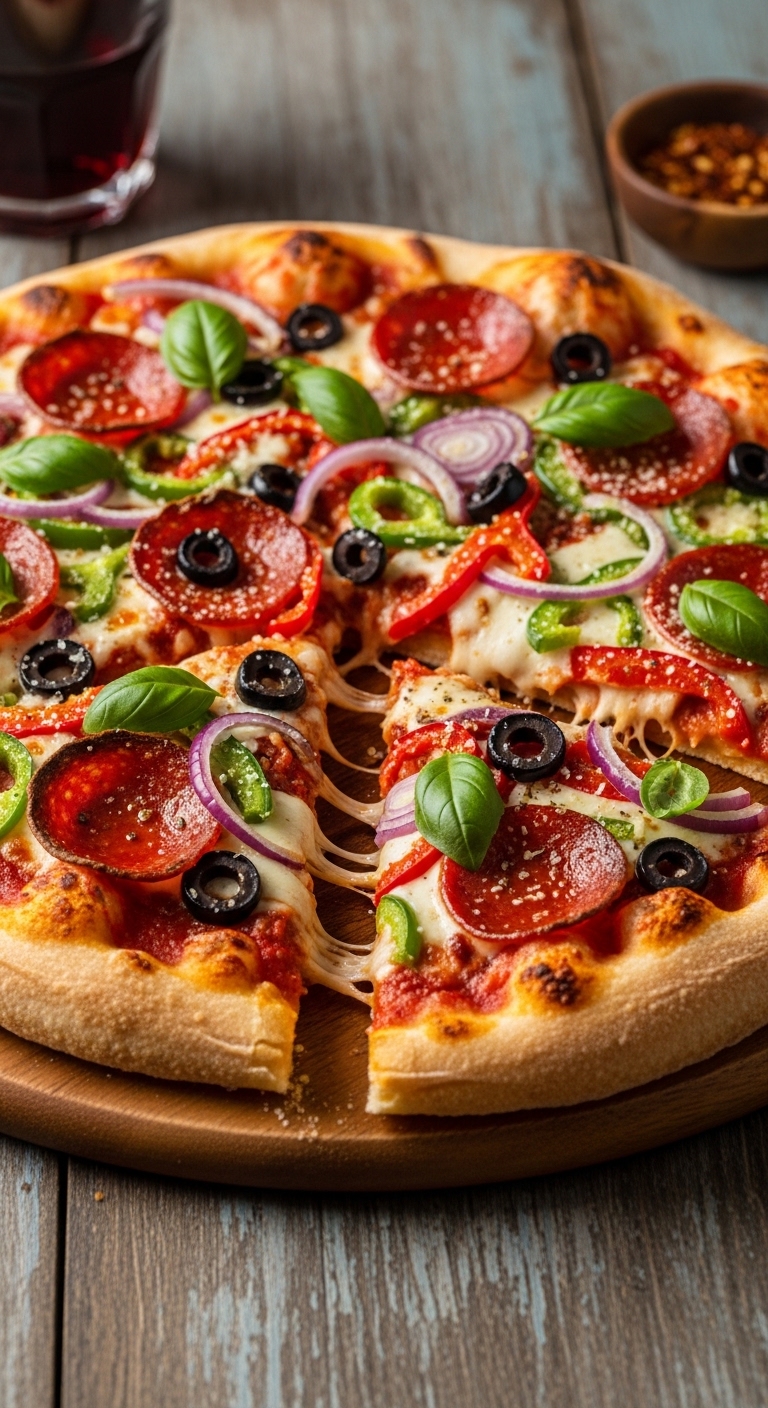
2. Pepperoni Pizza
America’s favorite. Layer generously with pepperoni slices that cup and char slightly at the edges for maximum flavor.
3. BBQ Chicken Pizza
Replace tomato sauce with BBQ sauce. Top with grilled chicken, red onion, mozzarella, and cilantro.
4. Vegetarian Garden Pizza
Mushrooms, roasted bell peppers, black olives, red onion, spinach, and sun-dried tomatoes.
5. Four Cheese Pizza (Quattro Formaggi)
Mozzarella, Parmesan, Gorgonzola, and Fontina. A rich, indulgent Italian classic.
6. White Pizza (Pizza Bianca)
Skip the tomato sauce. Use a garlic-infused olive oil base with ricotta, mozzarella, spinach, and a sprinkle of nutmeg.
Expert Tips for the Perfect Homemade Pizza
| Tip | Why It Matters |
|---|---|
| Use bread flour instead of all-purpose | Higher protein content creates a chewier, more elastic crust |
| Preheat your oven to maximum heat | Mimics the intense heat of a pizza oven for crispier results |
| Don’t over-sauce | Excess sauce leads to a soggy, undercooked center |
| Use low-moisture mozzarella | Prevents watery, greasy pizza |
| Cold-ferment your dough | Develops superior flavor and texture |
| Let the pizza rest before cutting | Allows cheese and sauce to set, preventing toppings from sliding |
| Invest in a pizza stone or steel | Dramatically improves crust crispness and heat distribution |
Nutritional Information (Per Slice — 1/8 of a 12-inch pizza)
Values are approximate and vary based on toppings.
| Nutrient | Amount |
|---|---|
| Calories | ~250–280 kcal |
| Carbohydrates | 32g |
| Protein | 11g |
| Total Fat | 9g |
| Saturated Fat | 3.5g |
| Sodium | 480mg |
| Fiber | 1.5g |
How to Store and Reheat Homemade Pizza
Refrigerator: Store leftover slices in an airtight container or wrapped in foil for up to 4 days.
Freezer: Freeze individual slices on a baking sheet until solid, then transfer to freezer bags. Keeps for up to 2 months.
Reheating (Best Method): Place slices in a dry skillet over medium heat, cover with a lid, and heat for 3–4 minutes. This restores the crispy crust without making the pizza dry or chewy. Avoid microwaving if possible — it makes the crust rubbery.
Frequently Asked Questions (FAQ)
Q: Can I make pizza dough without yeast? Yes. Combine 2 cups of self-rising flour with ¾ cup of Greek yogurt for a quick, yeast-free dough. The crust will be less airy but still delicious for a fast weeknight meal.
Q: What’s the best flour for pizza dough? For a chewy, New York-style crust, use bread flour (12–14% protein). For a tender, cracker-thin crust, use all-purpose flour. For an authentic Neapolitan pizza, use Tipo 00 flour, which is finely milled Italian flour.
Q: Can I use a regular baking tray instead of a pizza stone? Absolutely. Preheat an inverted heavy baking tray in the oven for best results. While it won’t replicate the exact crispness of a stone, it still produces excellent pizza at home.
Q: How do I prevent a soggy pizza crust? Use low-moisture toppings, don’t over-sauce, and bake at the highest oven temperature possible. Pre-baking (par-baking) the crust for 3–4 minutes before adding toppings also helps significantly.
Q: Why is my pizza dough tearing when I stretch it? This usually means the gluten is too tight. Let the dough rest at room temperature for an additional 10–15 minutes, then try again. Never force cold dough — always bring it to room temperature before shaping.
Final Thoughts
Mastering a homemade pizza recipe takes a little practice, but the results are well worth the effort. From the satisfying stretch of the dough to that first bite of crispy, cheese-covered perfection, there’s nothing quite like a pizza made entirely from scratch. Follow this step-by-step guide, experiment with your favorite toppings, and don’t be afraid to put your own spin on things.
Whether it’s a casual Friday night dinner or a weekend cooking project with the family, this pizza recipe is guaranteed to impress. Happy baking!